
Côte d’Ivoire is home to a rich variety of cultural traditions, languages, communities, and spiritual practices. Across generations, traditional beliefs and customs have played an important role in how many communities understand family, relationships, personal challenges, community life, and connection with cultural heritage.
When people search for traditional spiritual practices in Côte d’Ivoire, it is important to understand that there is no single practice that represents the entire country. Spiritual traditions can differ significantly between communities and regions. Some practices are connected to family heritage, ancestral traditions, prayer, ceremonies, symbolic practices, traditional healing, or consultation with respected spiritual practitioners.

For someone interested in traditional African spiritual guidance, learning about this cultural diversity is an important first step.
What Are Traditional Spiritual Practices in Côte d’Ivoire?
Traditional spiritual practices in Côte d’Ivoire refer broadly to cultural and spiritual customs that have developed within Ivorian communities over generations.
These traditions may include practices connected with:
- Prayer and spiritual reflection
- Ancestral remembrance
- Community ceremonies
- Traditional cleansing practices
- Symbolic rituals
- Divination
- Traditional healing traditions
- Family and community customs
- Spiritual consultation
- Cultural ceremonies surrounding important stages of life
The exact meaning and form of these practices varies from one community to another.
It is therefore more accurate to speak about different Ivorian spiritual and cultural traditions rather than suggesting that every community follows the same spiritual system.
Côte d’Ivoire’s Cultural and Spiritual Diversity
Côte d’Ivoire contains many ethnic and cultural communities, each with its own history and traditions.
For this reason, traditional spirituality should be understood within its cultural context. A practice associated with one community should not automatically be presented as a universal African or Ivorian practice.
Traditional African religions are widely recognized by scholars as diverse systems rather than one uniform religion. Many traditions are closely connected to particular communities, languages, histories, and social structures.
This diversity is particularly important when discussing spiritual guidance online.
A responsible spiritual platform should explain traditions respectfully rather than making broad claims about what all Africans believe or practice.
The Role of Spirituality in Traditional Communities
For many traditional communities, spirituality can be connected to everyday life rather than treated as something completely separate from culture.
Spiritual beliefs may influence how people think about:
- Family relationships
- Marriage
- Community responsibilities
- Personal decisions
- Life transitions
- Ancestral heritage
- Moral responsibilities
- Personal wellbeing
- Conflict and reconciliation
This does not mean that every individual in Côte d’Ivoire follows traditional spiritual practices.
Modern Ivorian society includes people with many different religious, cultural, and personal beliefs. Traditional practices may coexist with Christianity, Islam, secular perspectives, and other forms of spirituality.
Understanding this complexity helps create a more accurate picture of spiritual life in Côte d’Ivoire.
Traditional Spiritual Consultation in Côte d’Ivoire
One important aspect of traditional spirituality is the practice of seeking guidance from an experienced spiritual practitioner.
A consultation may provide an opportunity for a person to discuss personal concerns within a traditional cultural or spiritual framework.
Depending on the practitioner and tradition, a consultation may involve:
- A private conversation
- Discussion of the person’s concerns
- Spiritual reflection
- Prayer or traditional forms of contemplation
- Symbolic practices
- Traditional consultation methods
- Discussion of possible personal decisions
The experience can vary considerably.
There is no universal format for a traditional spiritual consultation in Côte d’Ivoire.
Traditional Spiritual Practices and Love
Love and relationships are among the reasons some people seek spiritual guidance.
A person experiencing relationship uncertainty may want to reflect on questions such as:
- Why is my relationship experiencing difficulties?
- How should I approach a separation?
- Should I consider reconciliation?
- How can I understand my emotions?
- What should I consider before making an important relationship decision?
- How can my cultural or spiritual beliefs help me reflect on my situation?
Traditional spiritual guidance can provide a cultural framework for reflection.
However, responsible spiritual guidance should not promise that a ritual can force another person to love someone, return to a relationship, or act against their wishes.
Relationships involve two people, and each person has their own choices and boundaries.
Ancestral Traditions and Cultural Heritage
Ancestral traditions are an important subject when discussing African spirituality, but they should be approached carefully.
Different African communities have different understandings of ancestors, family heritage, spiritual relationships, ceremonies, and remembrance.
For some communities, ancestors may be understood as part of an ongoing spiritual and cultural relationship between generations.
For others, ancestral customs may primarily be expressed through family traditions, ceremonies, stories, remembrance, and cultural identity.
These differences demonstrate why it is important to avoid presenting one specific belief as representative of every African community.
Traditional Cleansing and Spiritual Reflection
Traditional cleansing practices can be found in different African cultural contexts.
The meaning of cleansing varies according to the tradition involved. In some contexts, cleansing may symbolize renewal, transition, preparation, or the removal of perceived spiritual or emotional burdens.
A person seeking such guidance may describe feeling overwhelmed, emotionally unsettled, or in need of a symbolic new beginning.
Traditional cleansing should be understood as a cultural or spiritual practice rather than presented as a scientifically proven treatment for a medical or psychological condition.
Anyone experiencing a serious health concern should seek appropriate professional healthcare.
Prayer and Spiritual Reflection
Prayer is another practice that may appear within traditional or blended spiritual settings.
Prayer can provide time for:
- Reflection
- Gratitude
- Hope
- Personal intention
- Emotional expression
- Connection with one’s beliefs
The exact form of prayer depends on the person’s cultural and spiritual background.
For some people, prayer is deeply religious. For others, it may be part of a traditional spiritual consultation or personal reflection.
Symbolic Ceremonies
Traditional ceremonies can carry cultural meaning beyond their physical actions.
Objects, locations, words, gestures, clothing, food, natural elements, or other symbols may have particular meanings within specific communities.
However, symbolism cannot be separated from cultural context.
A particular symbol may have one meaning in one tradition and a completely different meaning elsewhere.
This is why an experienced practitioner should explain the cultural context of a practice rather than simply assigning a universal spiritual meaning to it.
Divination and Traditional Consultation
Divination is another subject commonly associated with traditional African spirituality.
Historically and culturally, different communities have developed different methods of seeking spiritual insight or interpreting symbolic information.
These methods are not identical across Africa.
If someone chooses to participate in a traditional divination practice, it is reasonable to ask the practitioner:
- What tradition does this practice come from?
- What does the consultation involve?
- What should I expect?
- Are there any costs?
- What are the limits of the practice?
- How will my privacy be treated?
A trustworthy practitioner should be willing to explain the nature of a consultation clearly.
Why Cultural Context Matters
The phrase “African spirituality” covers an enormous range of traditions.
Africa contains thousands of communities and languages, meaning that spiritual practices can differ dramatically.
Even within Côte d’Ivoire, cultural traditions can vary between communities.
This makes cultural accuracy particularly important for websites discussing African spiritual practices.
Instead of claiming:
“All African spiritual traditions believe…”
it is usually more accurate to say:
“Some traditional communities…”
or:
“Certain West African traditions…”
This approach respects the diversity of African cultures.
Traditional Spiritual Practices Around Tiébissou
Tiébissou is located in the Bélier Region of central Côte d’Ivoire and has a strong connection to the cultural landscape of the surrounding communities.
The area includes villages and communities where traditional customs and cultural heritage remain part of local identity.
For people interested in traditional spiritual guidance in the Tiébissou area, understanding the local cultural environment can be more meaningful than relying on generalized descriptions of “African spirituality.”
Local traditions should always be discussed with respect for the particular community, family history, and cultural background involved.
Choosing a Traditional Spiritual Practitioner in Côte d’Ivoire
If you are considering a traditional spiritual consultation, take time to evaluate the practitioner.
A professional and responsible practitioner should communicate clearly about the service being offered.
Consider the following questions:
1. Is the service clearly explained?
You should understand what type of consultation or traditional practice is being offered before agreeing to participate.
2. Are the costs transparent?
Be cautious when a practitioner refuses to explain fees or repeatedly demands unexpected payments.
3. Does the practitioner respect your decisions?
Spiritual guidance should not require you to surrender your ability to make personal choices.
4. Are guarantees being made?
Be careful with claims such as guaranteed love, guaranteed wealth, guaranteed marriage, guaranteed reconciliation, or guaranteed supernatural results.
No responsible practitioner can guarantee another person’s choices.
5. Is your privacy respected?
Personal relationship and family concerns can be sensitive. Ask how your information will be handled.
6. Are you pressured?
A consultation should not involve threats, intimidation, or pressure to keep paying money.
Traditional Spiritual Guidance and Modern Life
Traditional spirituality continues to exist alongside modern technology and contemporary life.
Today, someone interested in traditional spiritual guidance may live in a major city, another country, or outside Africa entirely.
The internet has also made it easier for people to discover cultural and spiritual traditions from different parts of the world.
However, online information should be approached carefully.
Not everything described as “African spirituality” online represents an authentic or historically established tradition.
Some websites combine different practices, while others use dramatic claims primarily as marketing.
Research, transparency, cultural respect, and responsible communication are therefore important.
Can Traditional Spiritual Guidance Replace Professional Services?
No.
Traditional spiritual consultation may be meaningful as a cultural, spiritual, or personal-reflection practice, but it should not replace professional medical, legal, financial, or mental-health services.
For example, someone experiencing serious physical symptoms should consult a qualified healthcare professional.
Someone facing legal problems should speak with an appropriate legal professional.
Someone experiencing serious emotional or psychological difficulties should consider qualified mental-health support.
Spirituality and professional services do not necessarily have to be treated as competing choices. A person may find personal meaning in spiritual traditions while also seeking appropriate professional assistance.
Traditional Spirituality as Cultural Heritage
Traditional spiritual practices are not only about rituals.
They can also represent history, identity, community, storytelling, values, and connections between generations.
For people of African heritage living outside Africa, learning about traditional practices can sometimes provide an opportunity to explore cultural history.
For visitors and researchers, it can provide insight into the diversity of Ivorian communities.
For individuals seeking spiritual guidance, cultural context can help them understand what a particular practice means rather than treating it simply as a mysterious ritual.
About Baba Houssou Kouakou
Baba Houssou Kouakou provides traditional spiritual guidance rooted in African cultural heritage.
His approach focuses on private consultation, personal reflection, love and relationship concerns, spiritual guidance, traditional practices, and cultural traditions.
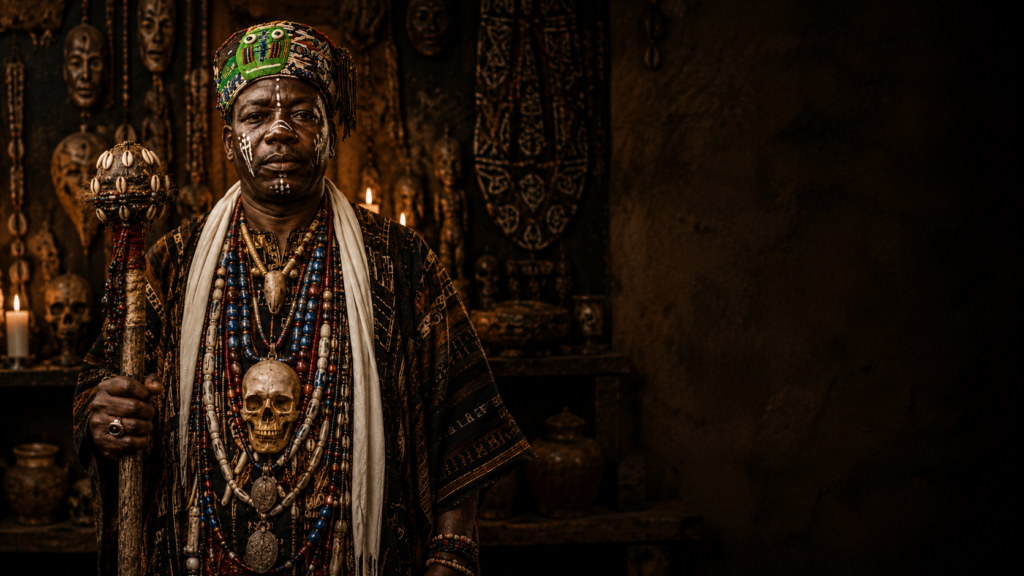
Consultations are intended to provide a respectful setting where individuals can discuss their concerns and explore them through a traditional spiritual perspective.
The purpose is not to promise guaranteed supernatural outcomes or control another person’s decisions.
Instead, spiritual consultation can provide an opportunity for reflection, cultural connection, and personal guidance.
Frequently Asked Questions
What are traditional spiritual practices in Côte d’Ivoire?
Traditional spiritual practices in Côte d’Ivoire include diverse cultural and spiritual customs that may involve prayer, ancestral traditions, ceremonies, symbolic practices, traditional consultation, cleansing, and other community-specific practices.
Is there one traditional religion in Côte d’Ivoire?
No. Côte d’Ivoire has diverse ethnic, cultural, and religious communities. Traditional spiritual beliefs and practices differ between communities.
What happens during a traditional spiritual consultation?
The process depends on the practitioner and tradition. It may involve discussing personal concerns, spiritual reflection, prayer, symbolic practices, or other traditional consultation methods.
Can traditional spiritual guidance help with relationship problems?
Some people seek spiritual guidance as a way to reflect on relationship concerns, emotional uncertainty, separation, or reconciliation. It should not be presented as a guaranteed method for controlling another person’s feelings or decisions.
What is traditional spiritual cleansing?
Traditional spiritual cleansing is a broad term that can refer to culturally specific practices associated with renewal, transition, purification, or spiritual reflection. Its meaning varies between traditions.
Are African spiritual traditions all the same?
No. African spiritual traditions are highly diverse and are often connected to particular communities, histories, languages, and cultural environments.
How can I choose a traditional spiritual practitioner?
Look for someone who clearly explains their services, communicates fees transparently, respects personal decisions and privacy, avoids guarantees, and does not use threats or pressure.
Final Thoughts
Traditional spiritual practices in Côte d’Ivoire are part of a much larger cultural landscape shaped by diverse communities, histories, beliefs, and traditions.
Understanding these practices requires more than simply listing rituals. It requires respect for cultural differences and recognition that African spirituality cannot be reduced to one universal system.
For someone interested in traditional spiritual guidance, a responsible approach begins with understanding the cultural context, asking questions, and maintaining personal judgment.
At LOVE | SPELL | MASTER, traditional spiritual guidance is presented as a cultural and personal-reflection practice rooted in African heritage.
If you are interested in learning more about traditional spiritual consultation, love and relationship guidance, or personal spiritual reflection, you can explore the available services and learn more about Baba Houssou Kouakou.
Keywords:
- traditional spirituality in Côte d’Ivoire
- African spiritual practices
- Ivorian spiritual traditions
- traditional African spirituality
- West African spiritual practices
- spiritual guidance Côte d’Ivoire
- traditional spiritual consultation
- African spiritual practitioner
- traditional cleansing practices
- ancestral traditions Africa
- spiritual guidance Tiébissou
- Côte d’Ivoire spiritual practitioner
Tags:
traditional spiritual practices, Côte d’Ivoire spirituality, African spirituality, West African spirituality, traditional African practices, spiritual consultation, ancestral traditions, spiritual guidance, Tiébissou, Ivorian culture