
A traditional African spiritual consultation is a private conversation or spiritual session in which a person seeks guidance through a particular African cultural or spiritual tradition. Depending on the community and practitioner, a consultation may involve prayer, reflection, symbolic practices, ancestral traditions, divination, ceremonial practices, or discussion of personal circumstances.
For someone unfamiliar with African spirituality, the idea of a spiritual consultation can raise many questions.
What actually happens during a consultation? What can you ask a traditional spiritual practitioner? Is every African spiritual consultation the same? Can it help with relationship concerns? And how should someone choose a practitioner?
The answers depend greatly on the cultural tradition involved.
Africa is a vast and culturally diverse continent, and there is no single spiritual system that represents every African community. Academic research emphasizes the diversity of African traditional religions, including differences in rituals, symbolism, beliefs, and cultural contexts.
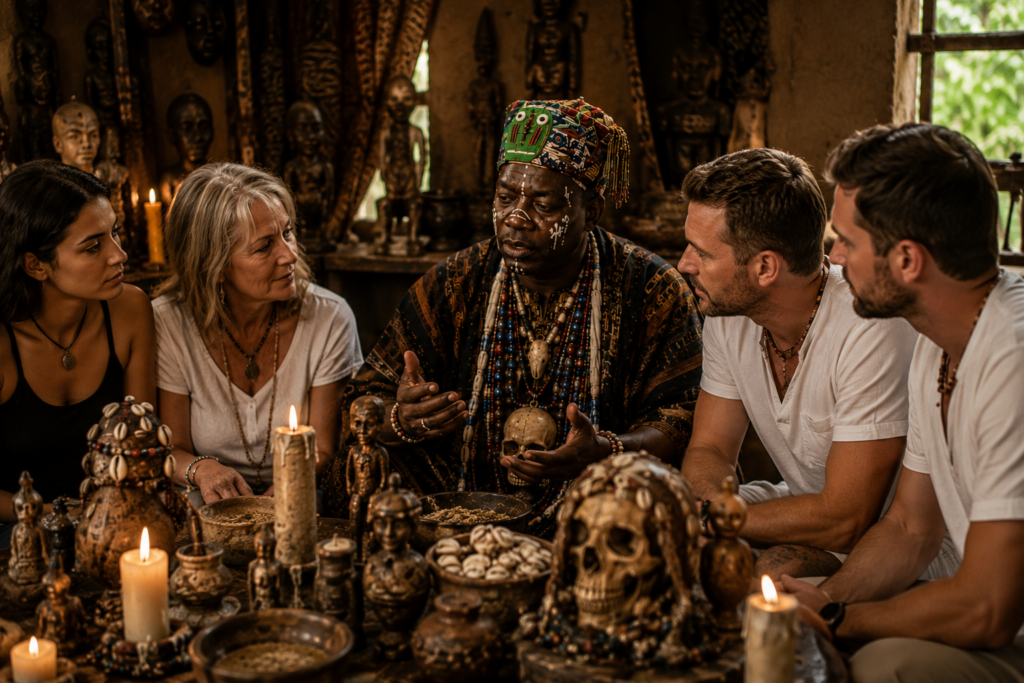
This article explains the concept of traditional African spiritual consultation, what people may seek from it, and how to approach a consultation with realistic expectations.
What Does African Spiritual Consultation Mean?
The word “consultation” generally suggests seeking advice, interpretation, reflection, or guidance.
In an African traditional spiritual context, consultation can refer to approaching a practitioner who has knowledge of a particular spiritual or cultural tradition.
The exact nature of the consultation varies.
In some traditions, a practitioner may use prayer or conversation. In others, symbolic objects, divination methods, ceremonies, ancestral traditions, or other culturally specific practices may be involved.
Traditional African spiritual practices are not organized around one universal set of rules. Different communities have developed their own ways of understanding spirituality, family, community, nature, ancestors, and the unseen world.
For that reason, an African spiritual consultation should always be understood within its particular cultural context.
Is There One African Spiritual Tradition?
No.
This is one of the most important things to understand before discussing African spirituality.
Africa contains thousands of communities and a wide variety of indigenous religious traditions. Scholars have repeatedly cautioned against treating African traditional religion as though it were one uniform religion.
Spiritual traditions can differ according to:
- Ethnic community
- Geographic region
- Language
- Family tradition
- Historical background
- Religious worldview
- Local customs
- Individual practitioner
For example, spiritual traditions found in West Africa are not necessarily identical to those found in Central, East, or Southern Africa.
Even neighboring communities may have different ceremonies, beliefs, terminology, and spiritual specialists.
Therefore, when someone says they are interested in an African spiritual consultation, the next question should be: Which tradition or cultural context?
Why Do People Seek African Spiritual Consultation?
People seek spiritual consultation for many different reasons.
Some are interested in their cultural heritage. Others are experiencing uncertainty in their personal lives and want a spiritual perspective.
Common areas include:
Love and Relationships
Relationship concerns are among the personal matters that can lead someone to seek spiritual guidance.
A person may be experiencing:
- Relationship uncertainty
- Emotional distance
- Communication difficulties
- Separation
- Reconciliation concerns
- Questions about compatibility
- Difficult personal decisions
- Anxiety about the future of a relationship
A consultation can provide a private opportunity to discuss these concerns from a traditional spiritual perspective.
Personal Decisions
Important decisions can sometimes leave people feeling uncertain.
A person may want to reflect on a career decision, family matter, relationship, relocation, or another major life change.
For someone who values spirituality, consultation may become part of their decision-making and reflection process.
Cultural Connection
Some people seek traditional spiritual practitioners because they want to reconnect with cultural traditions that were practiced by parents, grandparents, or earlier generations.
Spiritual traditions have historically been intertwined with many aspects of African community life, including family relationships, ceremonies, rites of passage, and social responsibilities.
Spiritual Reflection
Others simply want a space to reflect.
A spiritual consultation can give someone an opportunity to discuss questions about their beliefs, values, experiences, and personal circumstances.
What Happens During a Traditional Spiritual Consultation?
There is no universal procedure.
The consultation process depends on the practitioner and the cultural tradition involved.
However, a responsible consultation may begin with a conversation.
The practitioner may want to understand why the person has sought guidance and what questions or concerns they have.
This can make the consultation less about immediately performing a ritual and more about understanding the person and their circumstances.
A consultation may include:
- Introduction and conversation
- Discussion of the person’s concerns
- Questions about the situation
- Spiritual or cultural interpretation
- Prayer, reflection, or traditional practice where appropriate
- Discussion of possible next steps
Not every practitioner will follow these exact steps.
Why Listening Matters
A spiritual consultation should not be reduced to a collection of rituals.
Listening can be an important part of helping someone articulate what they are experiencing.
Relationship problems, for example, can involve complicated emotions.
A person may arrive believing they need a spiritual solution when what they really need first is an opportunity to explain what has happened.
By describing the situation, a person may gain a clearer understanding of their own concerns.
This is one reason a consultation can be valuable as a reflective experience, even for someone who approaches spirituality from a cultural rather than strictly religious perspective.
What Questions Can You Ask During a Consultation?
There is no single list of questions that everyone should ask.
Your questions should relate to your circumstances.
For relationship-related concerns, someone might ask:
- Why does my relationship feel uncertain?
- How should I approach a difficult relationship situation?
- What should I reflect on before making a decision?
- How can I approach reconciliation respectfully?
- What can I learn from my current relationship?
- How can I find greater clarity about my situation?
- What traditional practices are relevant to my concerns?
The purpose of these questions is not necessarily to obtain a guaranteed prediction.
Instead, they can help structure a meaningful conversation.
Can an African Spiritual Consultation Predict the Future?
People have different beliefs about spiritual consultation and divination.
Some traditional systems include practices intended to interpret circumstances, spiritual signs, symbols, or possible influences.
However, claims about the future should be approached carefully.
A consultation should not be presented as an absolute guarantee that a particular event will happen.
Human decisions and circumstances change.
Relationships especially involve the independent choices of multiple people.
For example, someone should be cautious about anyone claiming that a consultation can guarantee that another person will fall in love, return to a relationship, or behave in a predetermined way.
A more responsible approach recognizes uncertainty and personal agency.
African Spiritual Consultation and Love Relationships
Love is one of the areas in which people frequently seek guidance.
A relationship may begin with excitement and gradually become complicated.
Partners may disagree. Communication can break down. Distance may develop. A relationship may end unexpectedly.
During such periods, people may search online for spiritual guidance because they want clarity or hope.
A traditional spiritual consultation can provide a cultural framework for reflection.
It may encourage someone to consider questions such as:
What do I really want from this relationship?
What caused the conflict?
Have I communicated clearly?
Am I respecting the other person’s choices?
What can I change about my own behavior?
Would reconciliation genuinely be healthy for both people?
These questions can be useful regardless of a person’s religious background.
Can a Spiritual Consultation Make Someone Love You?
There is an important distinction between seeking guidance and trying to control another person.
A spiritual consultation should not be presented as a guaranteed way to control someone’s emotions or decisions.
Healthy relationships depend on mutual interest, communication, respect, trust, compatibility, and consent.
If someone does not want a relationship, their decision should be respected.
Spiritual guidance can be used for personal reflection, but it should not be treated as permission to ignore another person’s boundaries.
Traditional African Spiritual Consultation and Cultural Heritage
Traditional spiritual practices are closely connected with cultural history in many African societies.
Academic literature describes African religious traditions as diverse systems connected with local communities, customs, ceremonies, symbolism, and ways of understanding the relationship between human beings and the spiritual world.
This cultural dimension is important.
A traditional consultation is not simply a generic “African ritual.”
The meaning of a practice may depend on:
- Where the tradition comes from
- Which community practices it
- What the symbols represent
- The role of the practitioner
- The person’s own beliefs
- The cultural context of the ceremony
Understanding that background can make a consultation more meaningful.
West African Spiritual Consultation
West Africa has a particularly rich history of indigenous spiritual traditions.
Different societies have developed different forms of religious specialists, healers, diviners, ceremonial leaders, and spiritual advisers.
Research on West African traditions shows that the concept of spiritual consultation cannot always be translated neatly into Western categories. Different societies may use different terms and understand the role of a practitioner differently.
This is why it is better to ask a practitioner about their own tradition and approach rather than assuming that every spiritual practitioner follows the same system.
Traditional Spiritual Guidance in Côte d’Ivoire
Côte d’Ivoire is home to numerous cultural communities and traditions.
Central Côte d’Ivoire, including the broader area around Tiébissou, has strong connections with Baoulé cultural heritage.
For someone seeking traditional spiritual guidance in Côte d’Ivoire, cultural context can therefore be particularly important.
A practitioner working within a local or West African cultural tradition may approach spiritual consultation differently from a practitioner from another part of Africa.
The important thing is transparency.
People considering a consultation should understand what type of guidance is being offered and what cultural or spiritual tradition informs the practice.
What Is the Role of a Traditional Spiritual Practitioner?
The role of a practitioner can vary considerably.
Depending on the tradition, a practitioner may function as a spiritual adviser, ceremonial specialist, cultural custodian, counselor, healer, or interpreter of traditional practices.
Research on traditional African healing has noted that traditional practitioners can have roles extending beyond physical remedies, including cultural education, counseling, and community-related functions.
However, these roles should not be generalized across every African community.
Each practitioner should be understood within their own cultural and professional context.
How to Choose a Traditional Spiritual Practitioner
If you are considering a consultation, take time to evaluate the practitioner.
1. Understand the Services
Look for a clear explanation of what the consultation involves.
You should know whether the service primarily involves conversation, prayer, traditional ceremonies, spiritual interpretation, or another practice.
2. Ask About the Tradition
A practitioner should be able to explain the cultural or spiritual background of their approach.
You do not need to understand every detail, but basic transparency is valuable.
3. Be Careful With Guarantees
Be cautious about absolute promises.
Statements such as “I guarantee your partner will return” or “I can control another person’s feelings” should be treated skeptically.
4. Protect Your Privacy
Relationship concerns can be deeply personal.
Before providing sensitive information, understand how your information will be handled.
5. Keep Your Independence
A consultation should not remove your ability to make your own decisions.
You should remain in control of your relationships, finances, health decisions, and personal choices.
What Makes a Good Spiritual Consultation?
A meaningful consultation does not necessarily need dramatic promises.
For many people, value can come from:
- Being listened to
- Discussing personal concerns
- Exploring cultural traditions
- Reflecting on difficult decisions
- Understanding personal beliefs
- Finding emotional clarity
- Considering possible paths forward
Spirituality can be deeply personal.
What is meaningful to one person may not be meaningful to another.
The most important consideration is whether the consultation is approached respectfully and honestly.
Spiritual Consultation Is Not a Replacement for Professional Services
Traditional spiritual guidance and professional services have different purposes.
If someone is experiencing serious mental-health difficulties, medical problems, abuse, threats, legal issues, or immediate danger, appropriate professional assistance should be sought.
Spiritual consultation can be a complementary cultural or personal practice, but it should not prevent someone from accessing qualified medical, psychological, legal, or emergency services when those services are needed.
About LOVE | SPELL | MASTER
LOVE | SPELL | MASTER offers private spiritual consultations through Priest Baba Houssou Kouakou.
The platform focuses on traditional spiritual guidance relating to love, relationships, personal challenges, life decisions, and spiritual reflection.
The consultation begins by listening to the person’s concerns and understanding their circumstances before discussing traditional spiritual approaches that may be relevant.
For people interested in exploring West African spiritual traditions in a private setting, the consultation provides an opportunity to discuss their concerns directly with a traditional spiritual practitioner.
Begin a Private Spiritual Consultation
You do not have to understand every aspect of African spirituality before asking questions.
If you are curious about traditional spiritual consultation, the best starting point may simply be an honest conversation about your circumstances and what you hope to understand.
Priest Baba Houssou Kouakou welcomes people seeking traditional spiritual guidance concerning love, relationships, personal matters, and life decisions.
Frequently Asked Questions
What is an African spiritual consultation?
An African spiritual consultation is a private form of guidance based on a particular African cultural or spiritual tradition. Depending on the practitioner, it may involve conversation, prayer, reflection, ceremonial practices, symbolism, ancestral traditions, or divination.
Is African spirituality one religion?
No. Africa has a wide variety of indigenous spiritual traditions. Beliefs and practices differ between communities, regions, languages, and cultural groups.
What happens during a spiritual consultation?
The process varies. A consultation may begin with a discussion of your concerns before the practitioner explains or performs appropriate traditional spiritual practices.
Can I ask about my relationship during a spiritual consultation?
Yes. Relationship concerns are one possible reason people seek spiritual guidance. You can discuss concerns such as uncertainty, emotional difficulties, separation, or reconciliation.
Can a spiritual consultation guarantee that my relationship will be restored?
No responsible practitioner should guarantee another person’s feelings or decisions. Relationships involve the choices and consent of everyone involved.
Is traditional African spiritual guidance the same everywhere?
No. African spiritual traditions are highly diverse, and practices can vary considerably between cultures and regions.
Is a spiritual consultation the same as therapy?
No. Spiritual consultation and professional therapy are different forms of support. Spiritual guidance should not replace qualified mental-health care when professional treatment is needed.
How do I choose a traditional spiritual practitioner?
Look for transparency about the practitioner’s approach, cultural background, services, fees, privacy practices, and expectations. Be cautious of guarantees or pressure to make decisions you are uncomfortable with.
Keywords:
African spiritual consultation, traditional African spiritual consultation, African spiritual guidance, traditional African spirituality, African spiritual practitioner, West African spiritual consultation, spiritual consultation for relationships, traditional spiritual guidance, spiritual practitioner Côte d’Ivoire, African spiritual practitioner Côte d’Ivoire, spiritual guidance for love, traditional spiritual practices